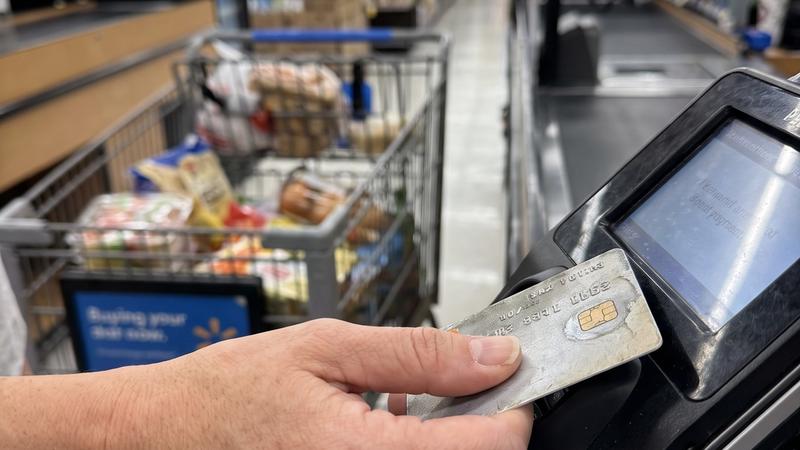
My debit card declined at the grocery store with a full cart, three kids, and a line of people behind me.
If you have never had it happen, let me tell you what it feels like. It feels like the whole store goes quiet and every single person is looking at you. They aren't. But that's how it feels.
The machine said DECLINED. I ran it again. DECLINED. I said, "Must be the chip," which is the lie everybody says, and the cashier gave me a small, tired nod, because she has heard that lie a thousand times.
My eight-year-old, Micah, looked up at me and said, way too loud, "Mom, are we okay?"
I said, "We're fine, baby." Another lie. Two in ten seconds. That's the kind of week it was.
How I Got to That Register
My husband left in February.
Not with a fight. Not with a note. He just got quieter and quieter until one day the quiet was the whole house, and his side of the closet was empty, and that was that.
So it was me. Three kids, a rent I signed for two incomes, and a job doing overnight stock at a distribution center that paid just enough to keep the lights on if nothing went wrong.
Something always went wrong.
That week it was the car. Four hundred dollars for a part I'd never heard of, and without the car there was no job, so the four hundred came out of the grocery money, and that is the whole reason I was standing at that register doing math in my head with a cart full of store-brand cereal.
I'd already put things back. The grapes. The good coffee. A birthday candle set for Micah, because his birthday was that Saturday and I was pretending I had a plan for it.
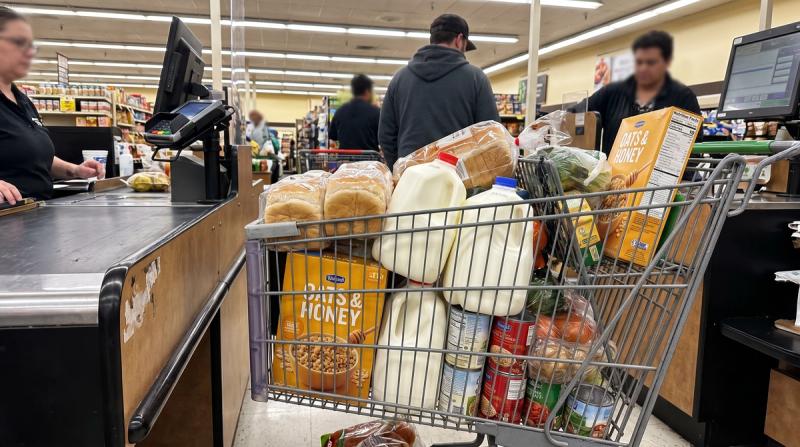
So no, that declined card was not a surprise to me. I knew what was in the account. Thirty-one dollars. I was just hoping the universe would round up, this one time.
It did not round up. It never does. Not on its own.
The Man in the Gray Jacket
The line behind me was five carts deep by now. Somebody sighed. Somebody else did that thing where they don't say anything but you can feel them wishing you would hurry up and be poor somewhere else.
I was about to tell the cashier to just take it all off, forget it, when a man reached past my shoulder and tapped his card on the reader.
Beep. Approved.
One hundred and forty-one dollars and change. Gone. Handled.
He was older. Sixties, maybe. Gray windbreaker, gray hair, the kind of face you'd walk past a hundred times and never once remember. Nothing about him said money. Nothing about him said hero.
I turned around and just started talking. You know how you do when you're overwhelmed. "No, I can't let you, please, give me your number, I'll pay you back Friday, I promise, I'm so sorry, you really don't have to do this."
He didn't answer any of it. He just stepped around me, picked up my bags off the little carousel, and started setting them in my cart. This stranger. Bagging my groceries like it was his job.
"Sir," I said. "Please. Why are you doing this?"
And that's when he leaned in, so the kids wouldn't hear, and he said the six words.
Six Words
He said: "A stranger did this for me."
That was it. That was the whole speech. He didn't explain it. He didn't wait for me to catch up. He gave my cart a little push toward the door, nodded at my kids, and said, "You've got good kids. Get them home."
And he walked back to his own groceries, which, I noticed, were about six things. A loaf of bread. A can of soup. A guy who clearly was not rich, who had just spent a hundred and forty dollars on a woman he'd never met.
I got the kids to the car. I loaded the bags. I sat down in the driver's seat and I did not start the engine, because I was crying too hard to see.
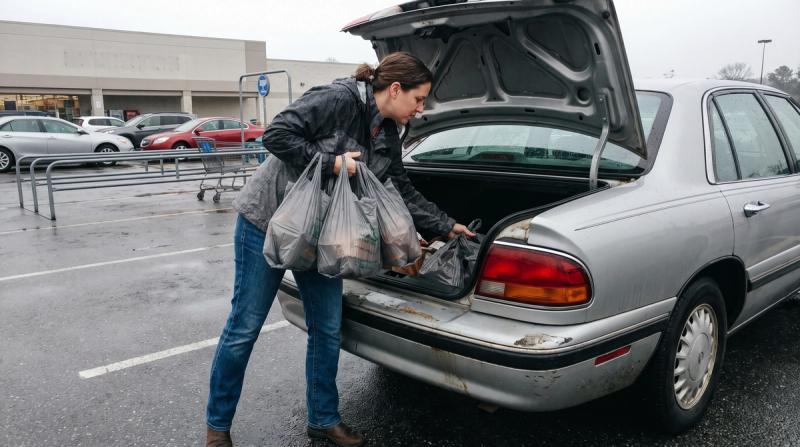
Micah, from the back seat, said, "Mom, is that the good kind of crying or the bad kind?"
And I laughed, this wet, ugly laugh, and I said, "The good kind, baby. Definitely the good kind."
What Was in the Bag
That night, putting the groceries away, I found something that wasn't mine.
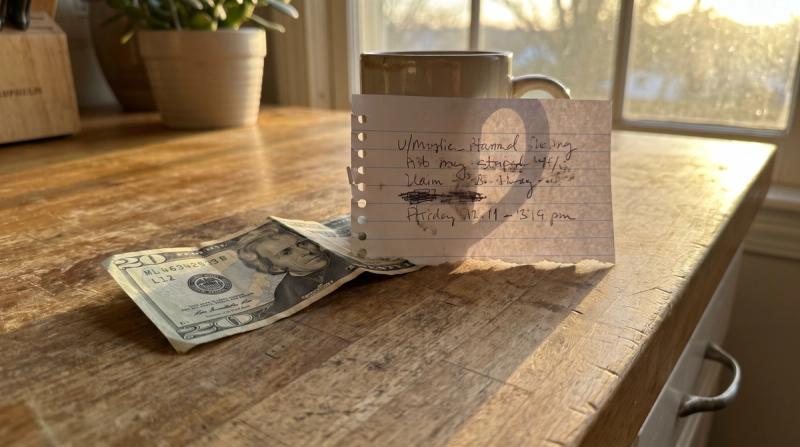
Tucked into the bag with the bread was a folded twenty-dollar bill and a scrap of paper. He must have slipped it in while he was bagging, when I was too busy falling apart to notice.
The note was in shaky blue pen. It said this.
For milk on the way home, and a candle for the birthday. I saw you put it back. Don't pay me back. Pay it forward, when you're able. You will be able. A stranger did this for me once, and look, I turned out fine.
He'd seen the candles. This man had watched me put a two-dollar pack of birthday candles back on the shelf, and it had stayed with him, and he'd left me twenty dollars so my kid could have candles.
Let me be straight with you. I have been through a lot of things in my life that were supposed to break me, and most of them didn't. That little note nearly did. In the good way.
I Went Back to Find Him
Micah got his birthday. Candles and all.
I made a boxed cake, the funfetti kind, and I stuck all twelve candles from Frank's pack into it even though the boy was only turning nine. Because when you have almost not been able to afford candles at all, you use every single one you've got.
He wished for a dog. He is not getting a dog. But he scrunched up his whole face and wished so hard the table shook, and I stood there thinking about a man in a gray jacket, and I thought: some wishes come true because a stranger just decides they will.
Things got a little better after that. Not because of a hundred and forty dollars, that's not what I mean. Because something in me stood up a little straighter. When a total stranger decides you're worth catching, you start to think maybe you're worth catching.
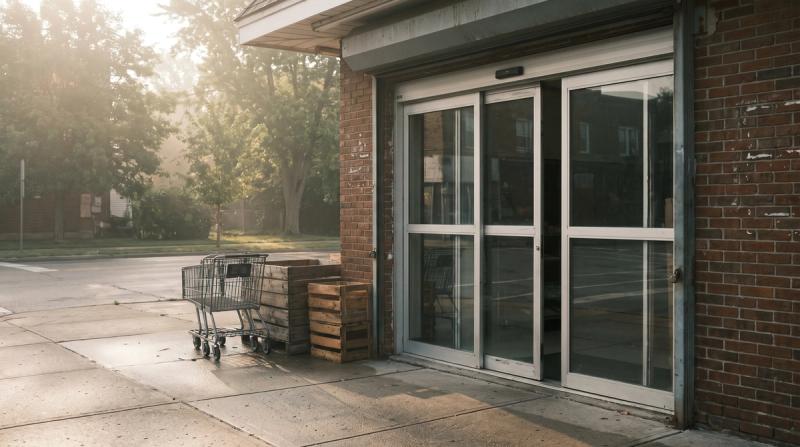
About two months later, when I was back on my feet enough that it wouldn't hurt us, I went back to that store on a Saturday morning with sixty dollars in my pocket. I wanted to leave it with a cashier, to cover the next person whose card said DECLINED. And I wanted to find the man in the gray jacket and say thank you like a real human being, not a stammering mess.
I asked the manager if he knew a regular, older gentleman, gray jacket, who did kind things at the register.
The manager's face changed. He said, "You mean Frank."
What They Told Me About Frank
Frank had been coming to that store for years. And for years, without a word to anyone, he had been doing exactly what he did for me. Watching the register. Stepping in when somebody's card declined and a kid was watching. Slipping a folded bill into a bag.
The manager told me Frank's wife had been a young mother once, decades ago, alone, broke, humiliated at a checkout counter in another town, in another life. And a stranger had covered her groceries and told her to pay it forward when she could.
She spent the rest of her life paying it forward. And when she died, Frank kept doing it for her. In her name. He never told anybody. The staff only knew because they saw it happen, over and over, at that register.
One of the cashiers, a young woman named Bree, came over while we were talking. She said Frank knew every one of their names. Asked about their classes, their kids, their bad knees. Tipped the boys who collected the carts out in the cold.
She said the day of his wife's funeral, Frank still came in for his loaf of bread and his can of soup. And still, on the worst day of his life, paid for a young dad's diapers two lanes over, and walked out before anybody could say a word about it.
"He'd love to hear he made a difference," the manager started to say, and then he stopped. And his voice went careful, the way people's voices go when they're about to hand you something heavy.
Frank had passed away five weeks earlier. Not long after the morning he paid for my groceries. I had missed my chance to thank him by about a month.
So I Do It Now
I stood in that grocery store and cried for the second time over a man whose last name I never even learned.
Then I did the only thing that made any sense. I gave the manager my sixty dollars and I said, "The next time somebody's card declines and there's a kid watching, this is for them. Don't tell them who it's from. Just tell them a stranger did this for them once."
I go back and do it when I can. It's not always sixty. Sometimes it's ten. Once, a really good month, it was a hundred. The cashiers know me now. We don't make a thing of it.
Because here's what Frank understood, and what I finally understand now.
Nobody claws their way up alone. Not really. Every single one of us who is standing is standing partly because at some point, somebody we couldn't pay back reached past our shoulder and tapped their card on the reader and said, in one way or another, I've got this one.
You don't pay that back. You can't. The person's gone before you even understand what they gave you.
Micah's nine now. He still remembers the man in the gray jacket. Sometimes when we're at the store and we see somebody counting change, he tugs my sleeve and looks up at me, and he doesn't even have to say it.
We've got this one. Thank you, Frank.