Now, I am a nosy woman, and I will not pretend otherwise. For two years I gave the old man on the bench outside my café a free breakfast every single morning, and in all that time I never once asked him a real question about who he was. Which, for me, is practically a miracle of restraint.
My regulars thought I had lost my mind. My accountant told me, in writing, that I could not afford it. And the whole time, I had no idea what was actually happening on that bench.
I thought I was the one giving. I was wrong about that, as it turned out. I did not find out how wrong until a woman in a grey suit stepped out of a black car and told me to sit down.
But I am getting ahead of myself. Let me start with the empty mornings, and the man who filled them.
The Café My Husband Left Behind
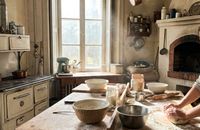
My name is Marie, and I have run the Bluebird Café for nineteen years. It was my husband David's dream, if I am honest, and never quite mine. We opened it together, back when the street was busier and the two of us were younger and certain of everything, which is a state I do not recommend but do rather miss.
David died six years ago. A heart attack, out of a clear blue sky, with no warning at all. After the funeral, everyone told me to sell up. Be sensible, they said. Let it go.
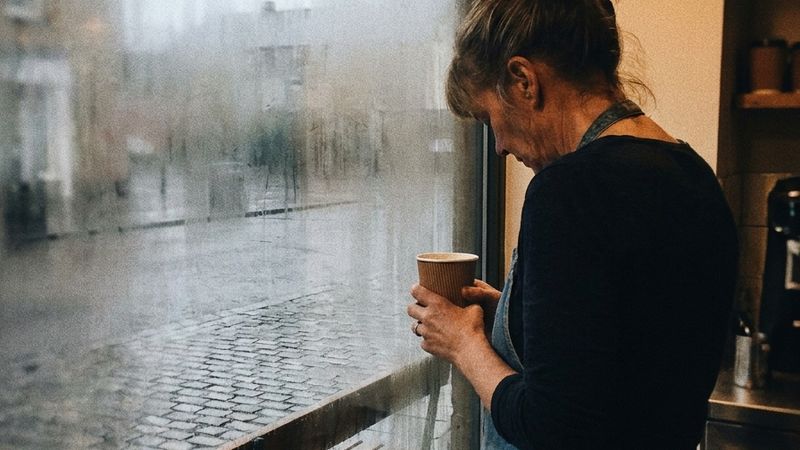
I couldn't. Closing it would have felt like losing him a second time. So I kept unlocking that door before dawn, every morning, to an empty street and a quiet I never did get used to. The Bluebird was not really a business anymore. It was the last place David still felt close.
It is a small place. Twelve tables, a counter with six stools, and a front window that looks out onto a street that used to be busy and, these days, is not.
The Man on the Bench
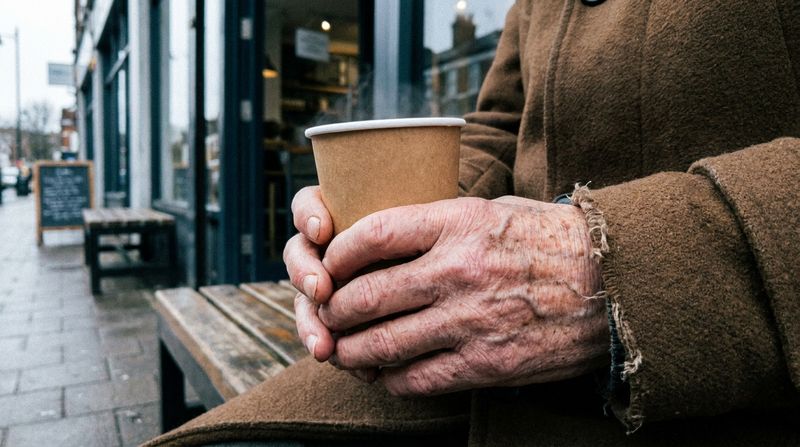
Walter first appeared on a grey morning in October. I noticed him because he sat so terribly still. An older man, seventy-five or thereabouts, in a heavy brown coat, on the little wooden bench right outside my window.
He had no sign. He had no cup out for coins. He simply sat, hands folded in his lap, watching the street the way some people watch the sea.
For three days I watched him from behind my counter (nosy, as I believe I mentioned). He never came in. He never asked a soul for anything. And something about the way he carried it got under my skin. I knew that particular stillness. I had been carrying my own version of it for six years.
On the fourth morning it was bitterly cold. I made a coffee, cream and two sugars, because I did not know how he took it and two sugars seemed a kindness, wrapped a bacon sandwich, and carried them out to him.
He looked up at me, then at the cup, then back at me.
"You don't have to do that," he said.
"I know," I said. "I'm Marie. What's your name?"
"Walter," he said, wrapping both hands round the cup as though it were the warmest thing he had held in years.
"Well, Walter," I said. "Cream and two sugars all right for tomorrow?"
He smiled then. It changed his whole face. "That would be very fine," he said.
Our Ritual
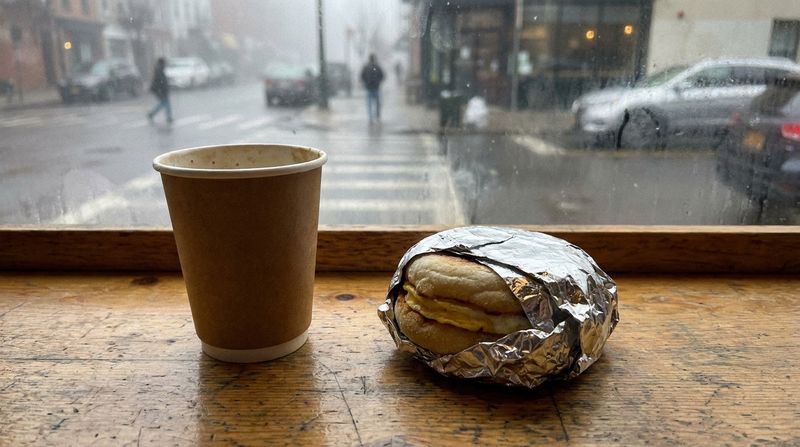
And that was that. Every morning for two years, Walter had a coffee, cream and two sugars, and whatever was freshest off my grill.
I would unlock the door at six, and he would already be there. I would bring his breakfast out, say a few words about the weather (I am English; there is always the weather), and go back to my day. He never came inside. I think he did not want to take up a paying seat.
We did not talk much, Walter and I. But you learn a person without words. I learned that his hands shook worse on the cold days. I learned he loved it when the sparrows came down to the pavement. And I learned that on the mornings I had had bad news, he somehow knew, and would say something small and steadying before I went back inside.
Some mornings I would find a single wildflower left on my windowsill. His way of saying thank you, I suppose. Some mornings I would slip a second sandwich into his bag and pretend I had not.
For the first time since David died, my mornings had a shape to them again. A reason to hurry with the coffee. Somebody waiting on the other side of the glass. I did not realise how badly I had needed that until a great deal later.
What the Regulars Said
Not everyone saw it the way I did.
The Bluebird was struggling. The rent went up every year, a big chain place opened two streets over, and some months I genuinely did not know how I would pay the wages of my one part-time waitress.
And there were regulars who felt that a shabby old man parked outside my window was not, shall we say, helping the ambience.
Doris, from the chemist across the road, was the loudest about it. "Marie, love, you can't even keep your own lights on," she said one morning, watching me carry Walter's tray out. "And you're feeding him for nothing. He can't pay you a penny."
"That's rather the point, Doris," I said.
She did not understand. A few others did not either. One man stopped coming in altogether and made quite sure I knew it was on account of "the vagrant out front."
I will not pretend it did not sting. When your business is drowning, every lost customer feels like a hand pushing you further under. There were nights I sat with my bills spread across a table and wondered whether the café David built would be gone by spring, and whether I would have anything left of him at all.
But every morning at six, Walter was on that bench. And I could no more stop bringing him his breakfast than stop breathing. Some things you simply know are right, even when they cost you.
The Morning He Didn't Come
Last Monday, it rained as though the sky had split open.
I unlocked the door at six, coffee already made, cream and two sugars, and carried it out under an umbrella. The bench was empty.
I told myself he was sheltering under the awning at the bus stop. I left the coffee on the bench anyway, tucked against the armrest so the rain would not get in it. By noon it was cold and full of rainwater, and Walter had not come.
The next morning, the bench was empty. The morning after that, too. I made his coffee out of habit each day and stood at the window holding it, feeling more foolish and more frightened as it went on.
By Thursday I had a sick, sinking feeling I could not talk myself out of. Two years, and he had never missed a single morning. Not in ice, not in heat, not once.
And here is the part that shames me. I did not even know his surname. I did not know where he slept, or whether he had anyone, or how on earth I would find out what had become of him. I had let this man become the anchor of my entire day, and I had never once asked him enough to be able to look for him. So I just stood at my window and watched the rain fall on that empty wooden bench.
And then, a little after nine, a long black car pulled up to the kerb.
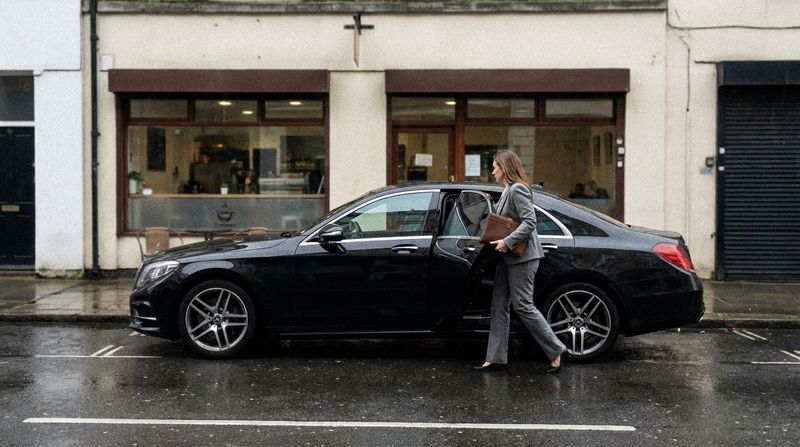
It was the sort of car that had never once parked on my street. Polished, black, expensive. A woman stepped out of it in a tailored grey suit, holding a leather folder over her head against the rain, and she walked straight to my door.
"Are you Marie?" she asked. "The lady who owns this café?"
"I am," I said.
"My name is Katherine Hall. I'm a solicitor." She paused, and her voice softened in a way that frightened me more than anything. "I've been looking for you. It's about Walter. Could we sit down?"
The Woman in the Suit
I brought her to the table by the window, the one with the best light, and made two coffees with hands that would not stay steady.
"Walter passed away last Sunday night," she said gently. "In his sleep. Peacefully. I'm so sorry to be the one telling you."
I had known it was coming, somewhere inside, since the first empty morning. But hearing it still knocked the wind clean out of me. I sat there and cried in front of a stranger, for a man whose surname I had never even learned.
Katherine waited, kind and quiet, until I could breathe again. Then she opened her folder.
"Marie, I don't think you know who Walter was," she said. "And he wanted it that way. But there are some things you need to understand now."
What she told me rearranged everything I thought I knew.
Walter had not been homeless. Not in the way I had assumed. Walter Prentice had been a builder, and then a developer, and by the end of his life a very wealthy man indeed. He owned properties across three counties.
"Then why," I started, and could not finish.
"Why did he sit on a bench in the cold every morning and let a café owner give him a free sandwich?" Katherine said. "I asked him that myself, more than once."
Eleanor's Café
"Walter had a wife," Katherine said. "Eleanor. They were married forty-one years. And for thirty of those years, Eleanor ran a little café. Much like this one."
I sat very still.
"Eleanor fell ill four years ago," she went on. "Toward the end, Walter told me, the world seemed to forget her. Old customers stopped coming. People who had eaten at her counter for decades could not seem to find the time. He watched his wife give her whole life to being kind to strangers, and then watched most of those strangers vanish the moment she needed them."
"After she died, he sold their house. He said it was too quiet." I flinched at that. I knew exactly what that quiet sounded like. "He took to driving in the early mornings, just to be moving. And one October morning he parked near a small café and sat on the bench outside, because it reminded him of Eleanor's place."
"That was my bench," was all I managed.
"That was your bench," Katherine said. "And on the fourth morning, a woman he had never met came out into the cold and handed him a coffee and asked him his name."
I had to put my hand over my mouth.
"He came back every day," she said, "because he wanted to know if it was real. Whether a person could be kind to a stranger who offered nothing in return, day after day, with no reward coming. He told me he had stopped believing that sort of person still existed."
"For two years, Marie, you were the proof he had given up on finding."
The Letter
Katherine took an envelope from her folder and set it on the table, along with a small set of keys. Then she told me the part I still cannot say aloud without stopping halfway through.
Eighteen months ago, my landlord had put the Bluebird's building up for sale. I had known it was coming. I had assumed it meant the end of me, that some developer would buy it, treble the rent, and turn the last piece of David I had into a phone shop.
A developer did buy it. Walter bought it. He had bought the ground under my feet a year and a half ago, and instructed his managers to keep my rent exactly the same, and never, under any circumstances, to tell me who the new owner was.
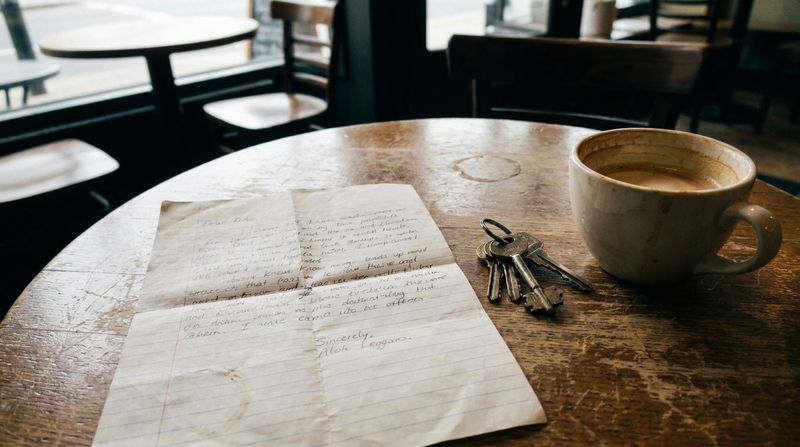
"He's left the building to you," Katherine said. "Outright. It's yours, Marie. There is also a trust, enough to keep the Bluebird running for the rest of your life, and then some. The keys are to the front door you already unlock every morning. He simply wanted you to hold them knowing they are truly yours now."
I opened the letter with shaking hands. It was written in a careful, old-fashioned script.
Dear Marie. My wife Eleanor spent thirty years being kind to people who mostly forgot her. When she was gone, I stopped believing kindness like hers was real. Then you walked out into the cold with a coffee and asked my name. You never knew who I was, and you were good to me anyway. That is the only kind of goodness that counts. The café is yours now. Keep the coffee on. And please, save a seat by the window. Yours, Walter.
At the bottom he had added one more line, and it is the line that undoes me every time.
Cream and two sugars. You remembered, every single day. Thank you for that.
The Seat by the Window
The Bluebird is still here. It always will be now. The worry that had sat on my chest since the day I buried David is simply gone, and some mornings I still cannot quite believe it.
For six years I kept this café alive because I could not bear to let go of my husband. Walter is the one who reminded me what David and I had opened those doors for in the first place. To be kind to whoever walked up to them. Especially the ones who could give nothing back.
Doris came in the week after and cried when I told her. She orders Walter's breakfast now, on occasion, cream and two sugars, and we do not say much about it.
There is a small brass plate on the bench outside now. It just reads: For Walter, who taught us who was watching. And there is a seat by the window that I keep clear, with a little card on it that most people never notice.
I used to think I was the one giving something, all those mornings. A coffee, a sandwich, a few kind words to a lonely old man who reminded me of my own loneliness.
I know better now. Walter was the one giving. He gave me two years of quiet company when I had none. He gave me a lesson I shall carry to my grave. And in the end he gave me back the café, and the man, and the reason I had very nearly forgotten.
All because one cold October morning I decided a stranger on a bench deserved a warm breakfast, and I never once stopped to ask what was in it for me.